
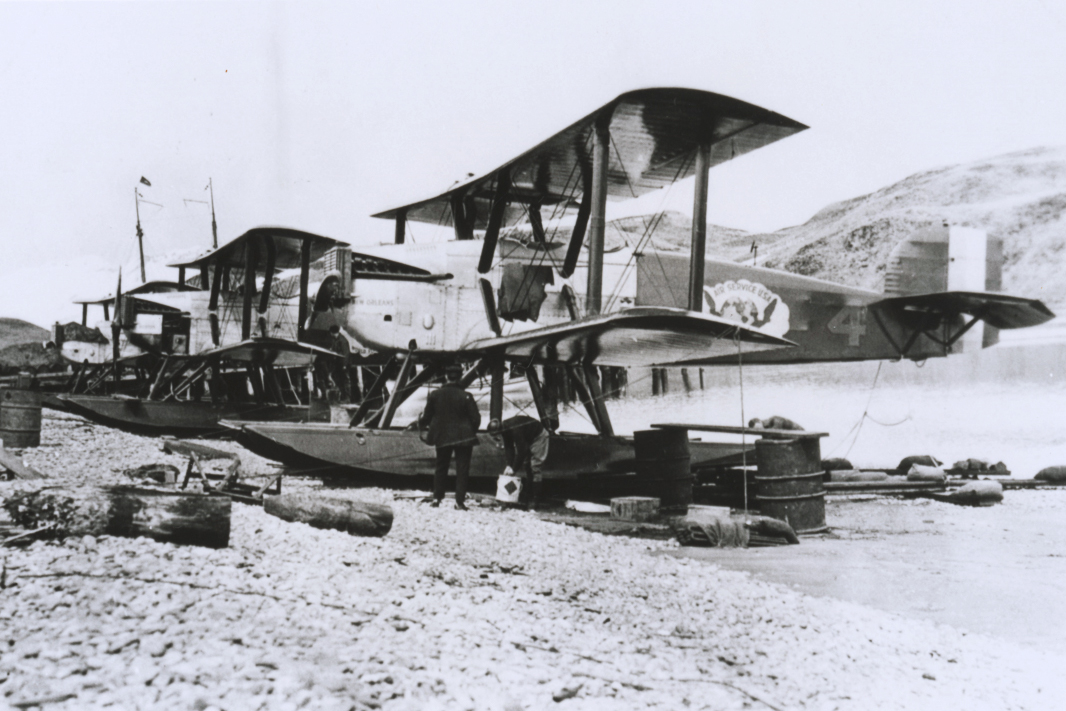
September 28, 1924, marks the day in history when the world got a little smaller. Four U.S. Army Air Service aviators touched down in Seattle, completing the first flight around the globe. It was a triumph of endurance, ingenuity, and courage that pushed the boundaries of aviation into a new era.
The Race to Circle the Globe
In the early 1920s, flying around the world was a dream waiting to be seized. Nations scrambled for the honor. The British attempted in 1922, followed by the French in 1923, with Italians and Portuguese also making plans of their own. The U.S. Army Air Service decided America should lead the way.
They needed the right machine. Enter Donald Douglas, who adapted his sturdy DT-2 torpedo bomber into a new design: the Douglas World Cruiser. Fitted with interchangeable wheels and pontoons, plus fuel tanks that stretched its range to more than 2,000 miles, it was purpose-built for the task. Four of these planes were delivered in early 1924, named for American cities: Seattle, Chicago, Boston, and New Orleans.
Into the Unknown
The journey began in Seattle on April 6, 1924. It would last for 175 days, covering over 26,000 miles and crossing 28 countries. The planes used for the expedition were equipped with no radios or advanced instruments; navigation depended solely on dead reckoning, maps, and a bit of luck. Disaster struck early on when the Seattle, piloted by expedition commander Major Frederick Martin, crashed in fog off the Alaskan coast. While Martin and his mechanic survived the crash, the aircraft was lost. The three remaining crews continued the journey, led by Lieutenant Lowell Smith and First Lieutenant Leslie Arnold in the Chicago.
They hopped across the Aleutians into Soviet territory, slipped through Japan, and swept down Asia. Along the way, the flyers survived crashes, mechanical failures, and monsoon rains. In Vietnam, the Chicago was stranded in a lagoon, its pilots fed by missionaries and locals until a new engine arrived. Over the Atlantic, when the Boston went down at sea, a U.S. Navy cruiser rescued the crew. The aircraft, towed in heavy seas, capsized and was lost forever.
Homecoming in Seattle
At last, two planes remained: the Chicago and the New Orleans. They crossed Europe, Greenland, and Canada before returning triumphantly to Seattle on September 28, 1924. Crowds of more than 100,000 greeted them. The trip had taken 363 flying hours and countless acts of skill and grit.
The surviving airmen, Smith, Arnold, Erik Nelson, and John Harding Jr., became instant heroes. Congress awarded them the Distinguished Service Medal, the first ever given for a peacetime act. Their success secured the Mackay Trophy for 1924 and etched their names into aviation history.
Why It Mattered
The flight demonstrated that the airplane was no longer merely a novelty for battlefields or a tool for stunts; it had become an instrument of global connection. The Douglas Aircraft Company proudly adopted the slogan, “First Around the World – First the World Around.” Within a generation, airlines would span oceans, and bombers would traverse continents. However, in 1924, it was four young men in open-cockpit biplanes who first proved that the sky had no limits.