
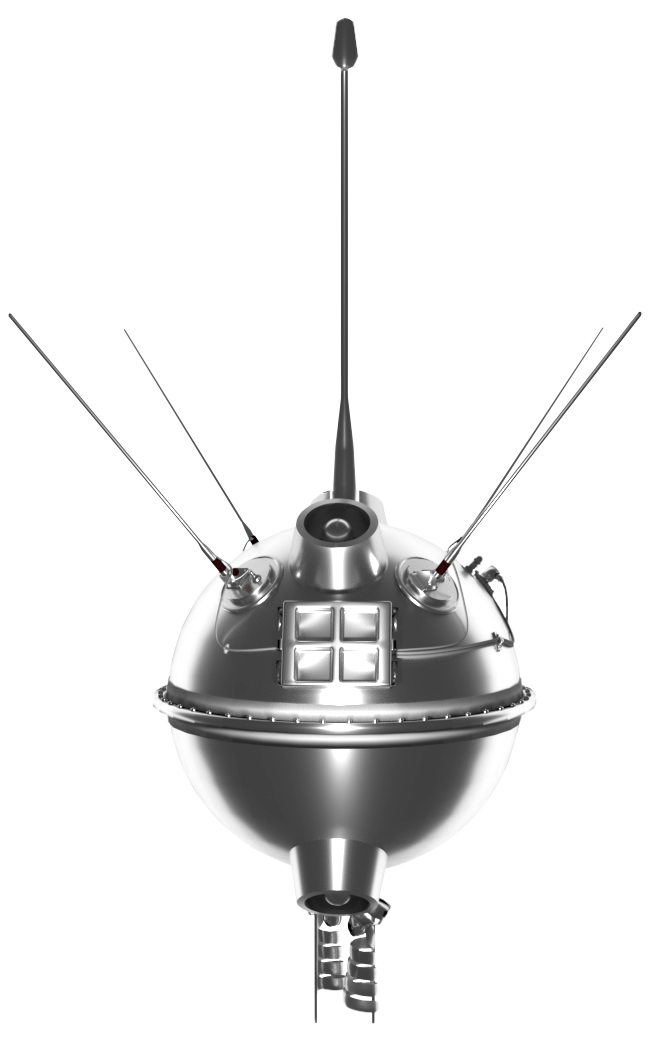
The Soviet Union’s Luna 2 became the first human-made object to reach another celestial body, crashing into the Moon and marking a pivotal achievement in the space race on September 14, 1959.
The Mission
Luna 2, sometimes called “Lunik 2,” was launched from the Baikonur Cosmodrome on September 12, 1959. The spacecraft was a spherical probe weighing approximately 390 kilograms, equipped with antennas, radiation detectors, magnetometers, and instruments designed to study cosmic rays and the solar wind.
Unlike earlier probes, Luna 2 followed a direct trajectory to the Moon, reaching speeds of more than 11 kilometers per second to escape Earth’s gravity. After a 36-hour journey, it struck the lunar surface near the craters Aristillus, Archimedes, and Autolycus at a speed of roughly 3 kilometers per second.
To make the mission visible to observers on Earth, the probe released a sodium vapor cloud en route, producing a glowing trail in the night sky. This display was seen from observatories across the Soviet Union and beyond.
Scientific Results
Luna 2 conducted several important experiments before its impact. Its detectors confirmed that the Moon has neither a significant magnetic field nor radiation belts, unlike Earth. The probe also collected new data on the Van Allen radiation belts, which contributed to a better understanding of how Earth interacts with solar particles. Additionally, its micrometeorite detectors recorded only a few minor impacts, alleviating concerns that space travel posed extreme risks from constant collisions with space debris.
Symbolism in the Cold War
Although Luna 2 made significant scientific contributions, its symbolic and political impact was even more profound. The Soviet Union had already shocked the world with its launch of Sputnik in 1957, but landing on the Moon solidified its reputation as the leader in space exploration.
This achievement came at a time when the United States was facing a series of rocket failures, heightening fears about Soviet superiority in missile technology. Shortly after the accomplishment, Soviet Premier Nikita Khrushchev visited the U.S. for a state visit. To emphasize this milestone, he presented President Dwight Eisenhower with a replica of the metallic pennants that Luna 2 had scattered across the Moon’s surface, which were engraved with the USSR’s name and the date of impact.
Luna 2 and Beyond
Luna 2’s success demonstrated that humanity could reach beyond Earth. It proved the ability to navigate spacecraft precisely enough to hit a moving celestial target, an essential milestone for later missions. Just three weeks later, Luna 3 would send back the first photographs of the Moon’s far side, further extending Soviet accomplishments.