
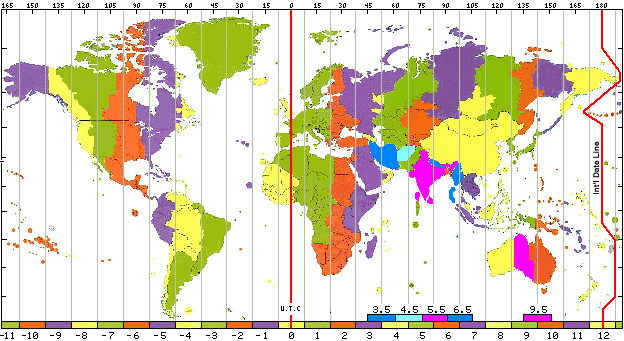
On October 13, 1884, a massive global decision transformed the way the entire world tells time. Forty-one delegates from twenty-five nations gathered in Washington, D.C., for the International Meridian Conference.
The outcome? A vote to adopt the Greenwich Meridian in England as the official Prime Meridian, the starting point for Universal Time and the entire system of global longitude.
A World Out of Sync
Before 1884, time was a local affair. Every city set its clock based on the sun, leading to confusion across continents and chaos for railroads and shipping routes.
- The U.S. alone had over 100 different local times.
- Railway stations ran on their own clocks.
- Navigators used dozens of prime meridians, from Paris to Rome to Washington.
This disjointed system made global communication, commerce, and travel inefficient and inconsistent.
The Road to Reform
The movement toward a universal time system began gaining traction in the mid-19th century. Railroads, astronomers, and scientists called for a global standard. Canadian engineer Sandford Fleming, an early advocate, proposed dividing the world into 24 time zones, all linked to a single Prime Meridian. By the early 1880s, the idea was ripe. President Chester A. Arthur called the conference in Washington, D.C., to choose a single reference meridian for timekeeping and navigation.
Why Greenwich?
The British had a head start. By 1884, over two-thirds of the world’s ships already used charts based on the Greenwich Meridian, thanks to the work of the Royal Observatory in Greenwich and Britain’s dominance in maritime navigation. Greenwich wasn’t just symbolic; it was practical. Its observatory had decades of precise astronomical records. It was already the de facto standard. The vote simply made it official.
The Conference and the Vote
On October 13, 1884, the delegates cast their votes:
- 22 nations voted in favor of Greenwich.
- 1 (San Domingo) voted against.
- France and Brazil abstained.
Though France opposed the symbolic dominance of Britain, it eventually adopted the system in 1911 (though it stubbornly referred to Greenwich time as “Paris mean time, retarded by 9 minutes and 21 seconds” for years).
What Changed?
The conference resolutions established:
- Greenwich as the Prime Meridian (0° longitude).
- Universal time is to be counted from Greenwich.
- A 24-hour day beginning at midnight in Greenwich.
- A hope (not a rule) that time zones and the nautical/astronomical days would align with the new system.
Though the conference did not formally establish time zones, it laid the groundwork. Within a year, railroads in North America implemented standardized time using the Greenwich system. Other nations followed suit.