
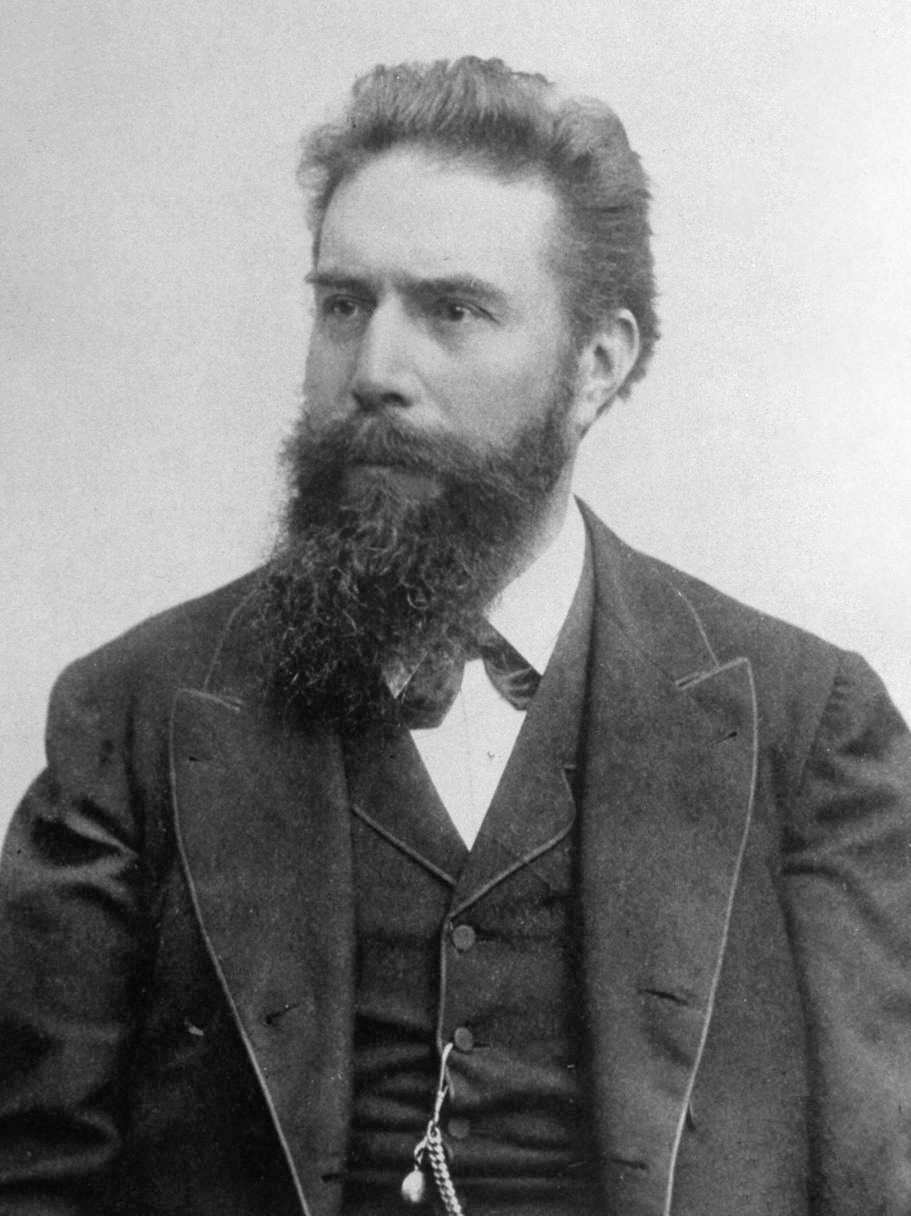
On this day in history, an accidental discovery changed the landscape of medical science forever. On November 8, 1895, Wilhelm Röntgen, a German physicist, was experimenting with cathode rays in his home laboratory when he noticed a fluorescent glow across the room. This observation led to the discovery of X-rays.
Early Life and Career
Wilhelm Röntgen was born in 1845 in Lennap, Prussia, but moved to the Netherlands when he was just three years old. Despite the brilliance he displayed throughout his scientific career, he struggled in school. He was expelled from his elementary school due to a prank, though he consistently maintained throughout his life that he had been falsely accused.
Röntgen’s path to obtaining a college education was challenging because he did not have a high school diploma. He faced rejection from several institutions but eventually passed the entrance exam for the Zurich Polytechnic in Switzerland in 1865. There, he studied mechanical engineering and earned his Ph.D. in 1869. Following his studies, he taught at several universities and held the Chair of Physics at both the University of Würzburg and the University of Munich.
The Discovery
During his time at the University of Würzburg, Wilhelm Röntgen spent many evenings conducting research in his laboratory. On November 8, 1895, he was working late on a cathode ray tube, a vacuum tube used to display images on a phosphorescent screen. To his surprise, he discovered that a fluorescent screen across the room was glowing, even though it was shielded by the cathode ray tube. Curious about this phenomenon, Röntgen began to investigate further. His exploration led to the accidental discovery of what would later be known as X-rays, a groundbreaking advancement for both the scientific and medical communities.
After his initial discovery, Röntgen spent weeks experimenting and documenting his findings. He took the first medical X-ray of his wife’s hand to demonstrate these results before sharing them with the world.
Legacy
Röntgen immediately shared his findings with the scientific community and decided against patenting his discovery. This decision facilitated rapid adoption in the medical field, allowing physicians to view the inside of the body without surgery, thereby significantly transforming medical practices almost immediately.
In 1901, Röntgen was awarded the first Nobel Prize in Physics for his discovery. Today, November 8th is recognized as International Day of Radiology in honor of the significant impact Röntgen’s discovery has had on the medical community.