
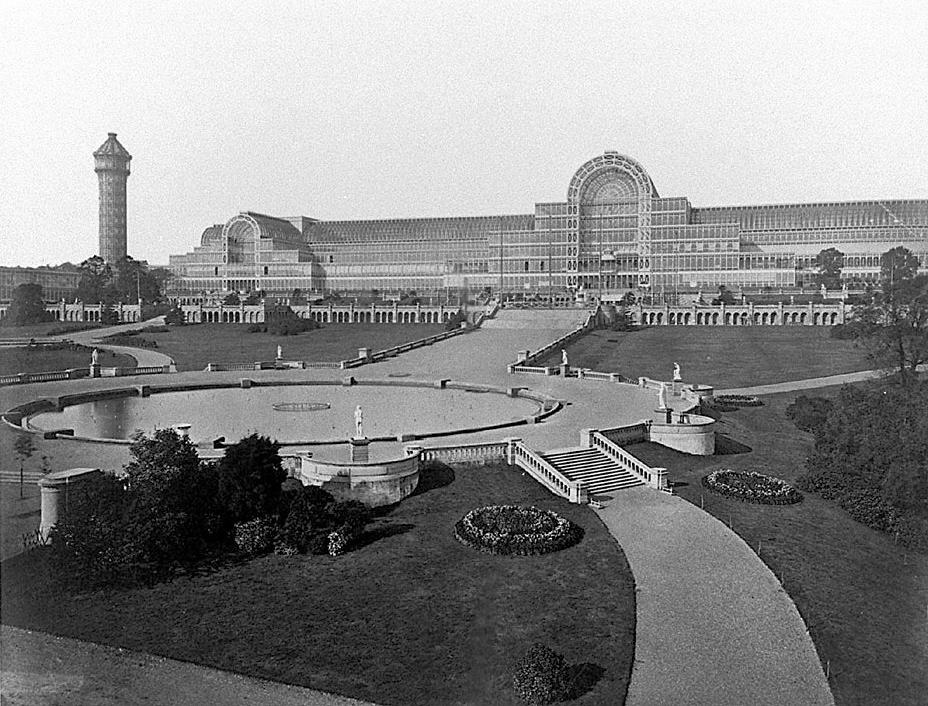
On the evening of November 30, 1936, flames lit up the sky over south London. The Crystal Palace, once a shining emblem of Victorian ambition and ingenuity, was reduced to smoldering ruins. The fire started quietly. Then it exploded.
Eyewitnesses reported seeing flames inside the enormous glass-and-iron structure just after dark. Within hours, the blaze had engulfed the building. Its glow could be seen from miles away. Thousands of stunned onlookers rushed to Sydenham Hill to watch in horror. Newspapers likened the crowd to a cup final. For many, it was like watching the past burn.
A Palace of Progress
The Crystal Palace began its life as the centerpiece of the Great Exhibition of 1851. Designed by Joseph Paxton, the structure was a marvel of prefabricated design. Made of plate glass and cast iron, it stretched nearly 1,850 feet in length and housed thousands of exhibits showcasing the industrial might of the British Empire.
After the exhibition, it was dismantled and moved to Sydenham, where it was reopened in 1854 as a permanent cultural venue. It hosted concerts, exhibitions, festivals, and even the first organized dinosaur sculptures in its surrounding park.
Neglect and Decline
Despite its early fame, the Crystal Palace struggled financially in its later years. Maintenance costs were high, and its Victorian grandeur seemed increasingly out of step with modern tastes. Several failed schemes to revive its fortunes only delayed the inevitable. When the fire broke out in 1936, much of the structure was already in a fragile state.
The Night of the Fire
Multiple fire brigades raced to the scene, but there was little they could do. The Palace’s design, its open spaces, dry timbers, and vast sheets of glass, turned it into a furnace. As the roof collapsed and iron beams twisted in the heat, the Palace that had once dazzled the world vanished into smoke and ash.
Two of the three nightwatchmen on duty later reported hearing what they thought were electrical failures. The exact cause was never determined.
As dawn broke over London, nothing remained but a skeleton of scorched iron. Even Winston Churchill, watching from the crowd, mourned its loss, saying, “This is the end of an age.”
A Memory in Smoke
The site has never been fully rebuilt. Though the surrounding park remains, and its dinosaur sculptures still draw visitors, the Palace itself became a ghost of imperial confidence and industrial pride. Proposals to rebuild have surfaced over the decades, but none have succeeded.