
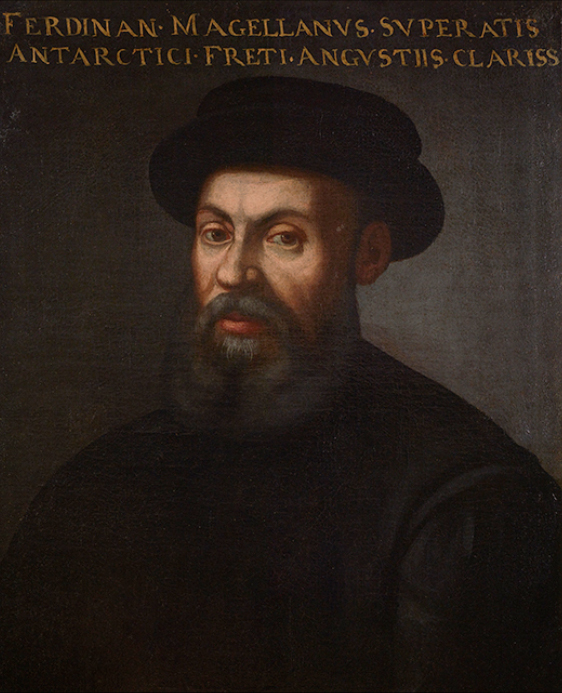
In the 1500s, European exploration was thriving. Countries were making significant advancements in navigation and shipbuilding, aiming to use this technology to amass wealth. Many nations sought new trade routes to India to profit from the lucrative spice trade and to bypass land-based rivals. Spain, a leading power of the time, was particularly interested in discovering new routes to the Spice Islands. King Charles I of Spain enlisted Portuguese explorer Ferdinand Magellan to find a westward route. On November 28, 1520, Magellan’s fleet became the first European ships to enter the Pacific Ocean while navigating new paths to the Spice Islands.
Ferdinand Magellan
Ferdinand Magellan was born into Portuguese nobility in 1480 and became a skilled sailor, serving the Portuguese Crown in Asia. He had a personal interest in sailing expeditions and sought to amass wealth through the support of monarchs. He proposed a plan to navigate a westward route around the Americas to reach the Spice Islands, presenting it to King Manuel I, the reigning King of Portugal. However, King Manuel refused to support Magellan’s plans.
Feeling daunted but determined not to give up, Magellan approached King Charles I of Spain with the same plan, seeking support for his idea. King Charles I approved the expedition, and in return, Magellan pledged his loyalty to the Spanish monarchy. He was appointed admiral of the Spanish fleet and given command of a five-ship fleet known as the “Armada of Molucca.”
Strait of Magellan
In September 1519, Magellan and his fleet set sail from Spain in search of a westward route to the Spice Islands. They spent 13 months traveling through the Atlantic Ocean and along the coast of South America, searching for a passage. In October 1520, they discovered a previously unknown strait that would eventually lead to the Pacific Ocean. This strait would later be named the “Strait of Magellan,” and the crew spent over a month navigating the 350-mile-long passage.
On November 28, 1520, the Strait of Magellan led the crew into the Pacific Ocean, becoming the first European ships to enter the waters. After a month of navigating the new body of water, Magellan named the Ocean “Pacific,” meaning peaceful, due to its calm appearance.
Significance
The crew would endure several more months at sea before finally reaching land, suffering from starvation and illness. Sadly, Magellan himself was killed in a battle with natives in the Philippines in 1521. However, his crew persevered and eventually completed the journey back to Spain.
Magellan’s voyage, although he did not complete it himself, was a monumental achievement as it demonstrated the existence of a passage between the Atlantic and Pacific Oceans. This voyage is recognized as a significant milestone in the journey of circumnavigating the globe and in the history of global exploration. Magellan’s expedition proved to the world not only that the Earth was round but also that it was much larger than previously thought.