
On this day in 1922, the world looked back and saw gold. British archaeologist Howard Carter, along with his patron Lord Carnarvon, became the first people in over 3,000 years to enter the nearly untouched tomb of Tutankhamun, the young pharaoh of Egypt’s 18th Dynasty. What they found inside would stun the world and ignite a century-long fascination with ancient Egypt.
All About Tut
Tutankhamun, known simply as “King Tut,” died at just 18. He ruled for less than a decade in the 14th century B.C. and left behind little legacy, until this moment. His name had all but vanished from history, scrubbed from monuments during a period of political and religious backlash. Even the location of his burial had been lost. But Carter refused to give up. Despite expert opinion that the Valley of the Kings had been fully excavated, Carter believed Tut’s tomb remained hidden.
Funded by Carnarvon, he spent years combing the desert. Finally, on November 4, 1922, his team uncovered a single step, but it led to a sealed doorway. Three weeks later, on November 23, they broke through the first barrier. A narrow passage lay beyond. At the far end: another door. Then, on November 26, Carter chiseled through the second seal and held up a candle to peer inside. Behind him, Lord Carnarvon asked, “Can you see anything?” Carter’s reply: “Yes, wonderful things.” And wonderful things they were.
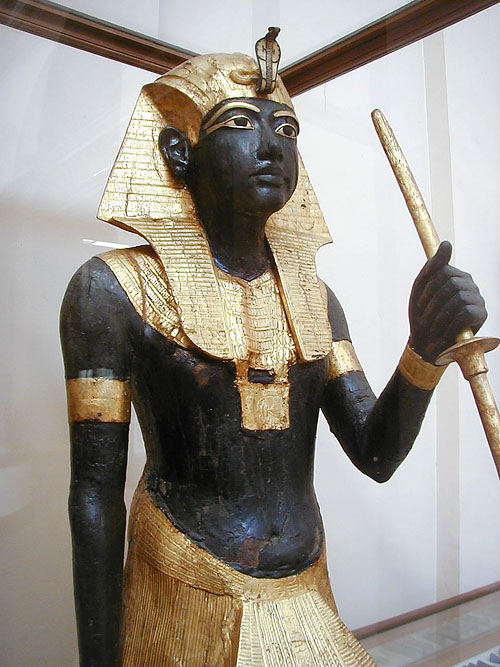
The flickering candlelight revealed a dazzling antechamber packed with objects: golden shrines, statues, furniture, chariots, and more.
What Happened Next
Carter’s team painstakingly excavated the four-room tomb over the next several years. It held over 5,000 artifacts, many of which were still in pristine condition. Among them were items Tutankhamun likely used in life, jewelry, clothing, weapons, and others crafted to accompany him into the afterlife. But nothing compared to what lay within the inner burial chamber: a stone sarcophagus holding three nested coffins. The innermost, made entirely of solid gold, cradled the mummified remains of the boy-king himself. It was one of the most significant archaeological discoveries of all time. The treasures offered an unprecedented look at royal life in ancient Egypt. The artistry, symbolism, and sheer splendor reignited public imagination. “Tutmania” gripped the globe.
Carter, once dismissed, became a household name. His discovery reshaped Egyptology and set new standards for excavation and preservation. Most of the treasures, including the golden coffin, now reside in the Egyptian Museum in Cairo.
As for Tutankhamun, the forgotten pharaoh had become immortal, his legacy secured not by the power he wielded in life, but by the secrets his tomb revealed.