
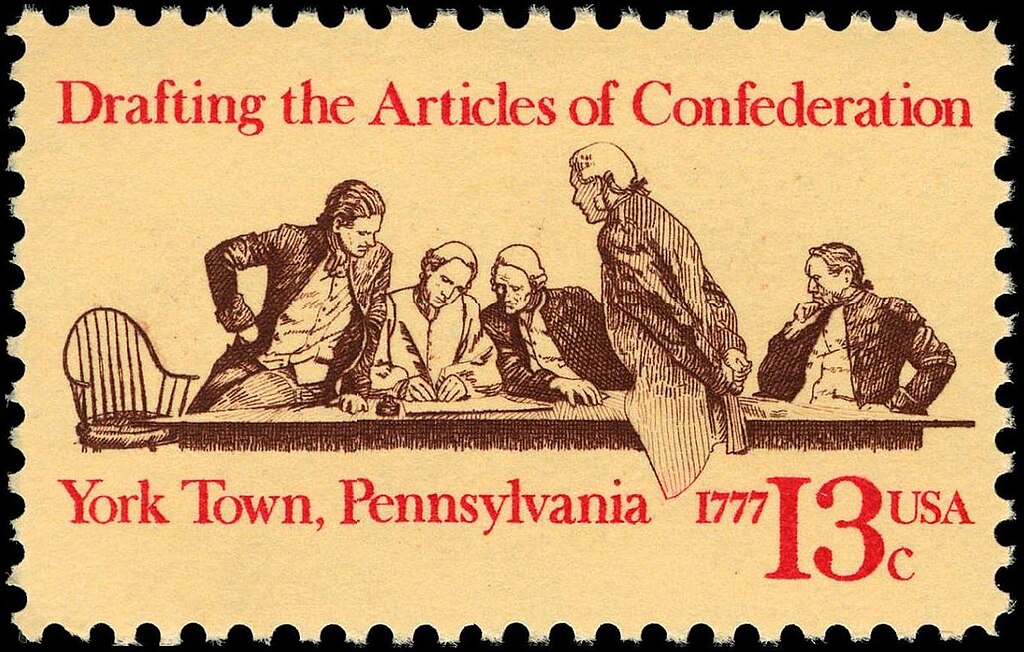
In 1776, the thirteen colonies of the United States officially declared their independence from Britain and set out to establish themselves as a new nation. To create a new government separate from that of Britain, the colonies formed the Second Continental Congress, a body composed of representatives from each colony. On November 15, 1777, the Continental Congress officially adopted the Articles of Confederation, which became the first constitution of the United States of America.
Initial Framework
When designing the initial government framework for the newly declared country, the colonists were strongly influenced by their resentment of Britain’s tight control over them. As a result, the Articles of Confederation were created to establish a weak central government, granting more power to the states out of fear of a strong national authority. The Articles instituted a unicameral legislature with one representative from each state, ensuring that each state had equal power.
The new government structure intentionally lacked many of the powers that frustrated the colonists about Britain. The Articles of Confederation did not grant the government the authority to tax the states; instead, it required the government to request funds from the states. Additionally, the government lacked the power to regulate trade or commerce, and no executive officials were appointed to enforce rules or regulations.
The Articles of Confederation formed a “League of Friendship” among the 13 states, creating a loose alliance that preserved individual sovereignty while promoting unity.
Ratification
The Articles of Confederation were drafted by John Dickinson, who chaired a 13-member committee of the Second Continental Congress. After several months of debate and revision, a draft was submitted to the committee. On November 15, 1777, Congress officially approved and adopted the Articles of Confederation.
However, the new framework also required approval from each individual state before it could be enacted. Ratification by the states took an additional 4 years, and it was officially ratified in 1781.
Failure
Although the Articles of Confederation addressed many of the colonists’ issues with British rule, the new framework ultimately proved to be ineffective.
- Because it lacked the power to tax, the government relied on funding from the states, which was often insufficient to meet the country’s needs.
- The government lacked the power to regulate commerce, leading to trade wars and disputes among the states.
- The government lacked the power to raise an army, so the country was unable to respond to internal and external threats effectively.
- Because they had not established a common currency in the Articles of Confederation, the economy was put into chaos.
- Amending the Articles required a unanimous vote from all thirteen states, which made it nearly impossible to achieve.
Ultimately, the states recognized that the Articles of Confederation were ineffective, leading to the calling of the Constitutional Convention in 1787, just six years after the Articles were implemented. Although the Articles of Confederation ultimately failed, they succeeded in providing a fresh framework for a brand-new country.