
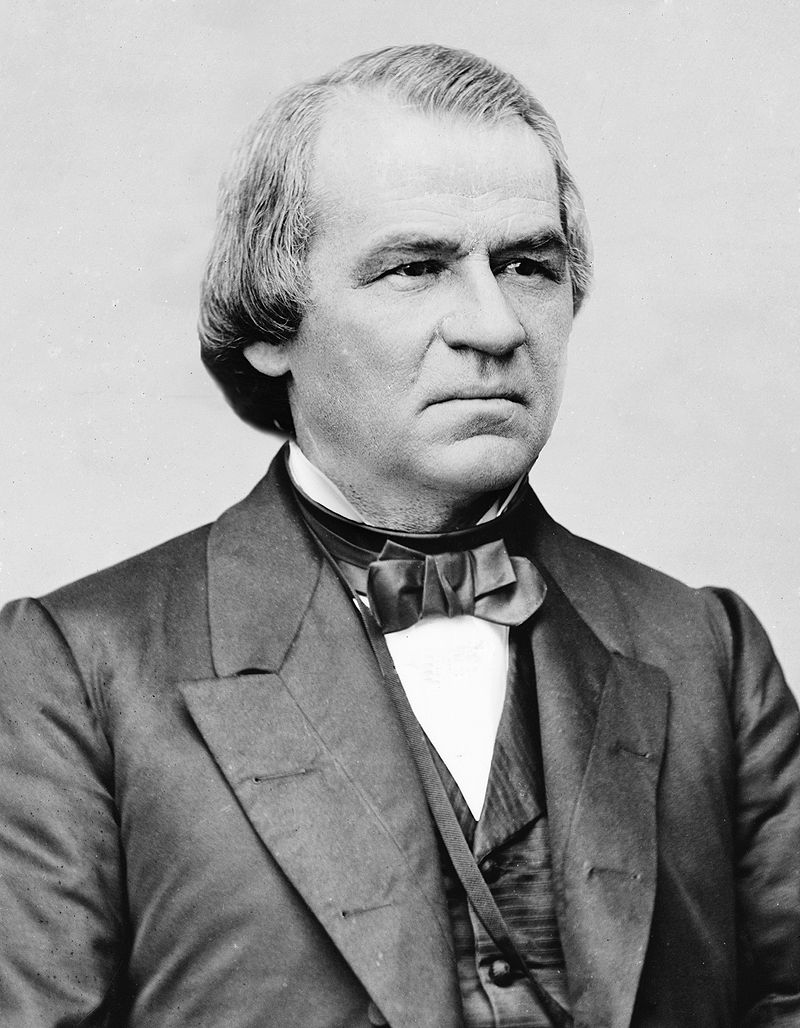
On July 31, 1875, former President Andrew Johnson passed away at the age of 66. After a long and intensely hot horseback ride to visit his daughter in Elizabethton, Tennessee, he suffered a massive stroke and did not recover. He was buried in his hometown of Greenville, Tennessee, wrapped in an American flag, with his tattered copy of the United States Constitution placed under his head as a pillow. His burial location eventually became the site of the National Cemetery of Andrew Johnson.
Andrew Johnson’s presidency was marked by controversy. He served as vice president under Abraham Lincoln and assumed the presidency after Lincoln’s assassination. Johnson held office from 1865 to 1869 during the challenging post-Civil War era, with the critical task of reuniting the seceded states as his primary focus. Although he supported the abolition of slavery, which he referred to as a “cancer” on the United States, he faced criticism for his lackluster approach to ensuring freedom for those who had been freed from slavery. His rapid and lenient method of Reconstruction for the southern states drew further scrutiny. In 1868, he was impeached by the House of Representatives for removing officials who opposed his policies and for clashing with Congressional efforts regarding Reconstruction. However, he was ultimately acquitted by the Senate. He sought the Democratic nomination for a second term in office, but he was not selected.
Fun Facts about President Andrew Johnson:
- Andrew Johnson ran away from his childhood home, where he had been promised by his mother to work as an apprentice for a local tailor. He eventually started his own tailoring business, which became very successful, allowing him to become an investor in real estate.
- He was unable to read or write for most of his young adult life, and he learned these skills from his wife, Eliza, after their marriage.
- Despite not being nominated for a second term as President, he was elected to the U.S. Senate in 1875, making him the only former U.S. President to later serve in the Senate.
- He was a huge advocate for the “common man,” and ran his platform against “plantation aristocracy.”
- He requested to be buried with an American flag and his personal copy of the United States Constitution- as was done after he died in 1875.