
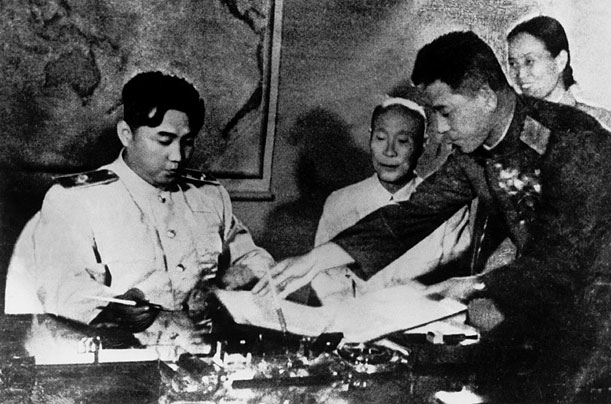
After World War II ended, political tensions began to rise, especially between the Soviet Union and the United States. As these two countries managed the withdrawal of Japanese forces from Korea, they agreed to divide the country along the 38th parallel. The Soviet Union would occupy the northern part, while the United States would take control of the southern part. This division quickly became a source of conflict, as the two nations could not agree on a governmental system. The United States supported the idea of democracy, while the Soviet Union aimed to establish a communist regime. This ideological divide ultimately led to the Korean War, which began when North Korea invaded the South. The conflict lasted from 1950 to 1953, spanning three years. The war came to an end with the signing of the Korean Armistice Agreement on July 27, 1953, which officially brought the fighting to a halt.
The Korean Armistice Agreement effectively halted the conflict, but it fell short of being a true peace agreement. It mandated a ceasefire, stopping all fighting and active military operations on both sides. The agreement also established a Demilitarized Zone, which is a 4,000-meter buffer between North and South Korea that serves as a boundary between the two nations. Additionally, it required the release of prisoners of war held by either side. A commission of neutral parties was created to oversee the implementation of the agreement’s terms. To this day, over 28,000 active U.S. military troops remain stationed in South Korea to monitor the ongoing security situation.
The impact of the Korean Armistice Agreement is complex. On one hand, it halted active fighting between North and South Korea. On the other hand, significant tensions persist, and occasional fighting and violations of the truce continue to occur. Furthermore, since the agreement was not a peace treaty, the Korean War technically remains unresolved to this day.