
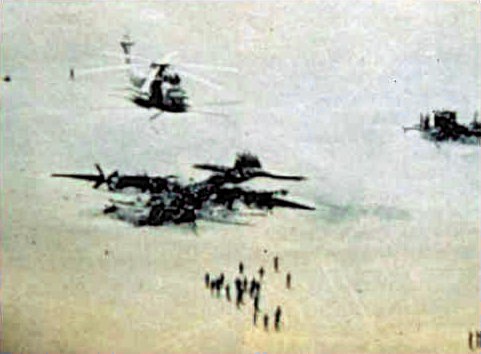
Operation Eagle Claw, a U.S. attempt to free American hostages held in Iran, began with a tragic collision in the Iranian desert on April 24, 1980, and ultimately failed to achieve its goal. Despite the delays and visibility issues caused by a haboob, a powerful sandstorm, the mission was underway. Tragically, a helicopter and a transport jet collided, resulting in the loss of eight brave servicemen (5 Air Force and 3 Marines) and the mission’s abandonment.
The ambitious plan called for flying a squad of special U.S. forces, including Army Rangers and Delta Force commandos, deep into Iran in the dark, meeting up at a remote desert location known as “Desert One,” and then traveling to Tehran the next night to raid the embassy and free the hostages. Only five of the eight helicopters dispatched to Desert One arrived in operational shape; one was lost in a dust storm, and another experienced mechanical problems and had to return. Commanders made the painful choice to abort. While refueling, a helicopter accidentally struck a parked C-130 transport jet while military forces were preparing to leave. A tremendous explosion from the collision killed eight American servicemen and injured many others.
The American public was outraged by this military and political disgrace, which exposed weaknesses in the coordination and command of special operations across the branches. President Jimmy Carter accepted full responsibility, and the episode hurt his chances of winning reelection. Eagle Claw was a turning point rather than merely a failure. The U.S. military reorganized its special operations troops as a result. In direct response to the logistics and coordination shortcomings that night, the 160th Special Operations Aviation Regiment was established to provide dedicated air support for such operations. The United States Special Operations Command (USSOCOM) was also formed to oversee and coordinate all special operations forces. These changes significantly improved the U.S. military’s ability to conduct complex and high-risk operations.
Despite its tragic conclusion, Operation Eagle Claw served as a valuable learning experience. The mission’s shortcomings paved the way for subsequent successes. Operations like the 2011 raid that killed Osama bin Laden were executed with the kind of coordination and precision that Eagle Claw lacked, demonstrating the lessons learned and the improvements made in the U.S. military.