
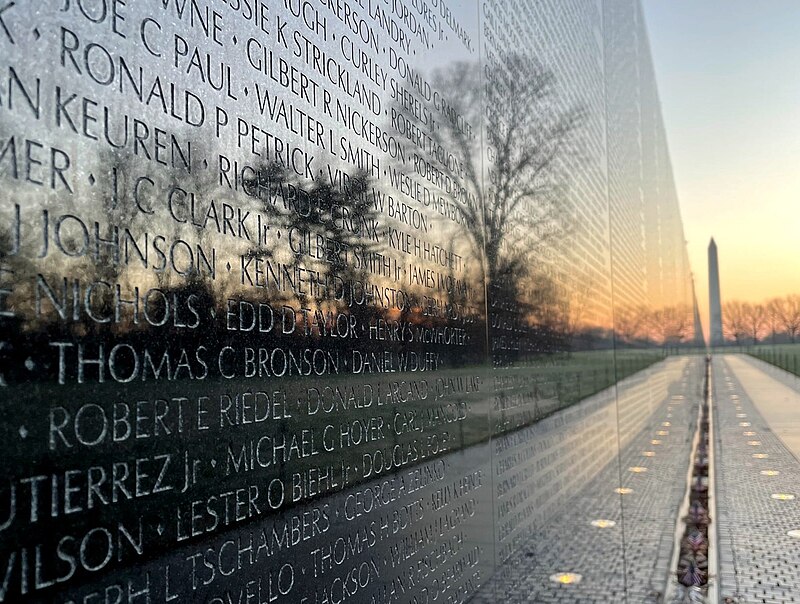
The Vietnam War lasted from 1955 to 1975 and was highly controversial in the United States, generating significant public opposition. Many people viewed it as an unnecessary conflict in the fight against the spread of communism, and the loss of nearly 58,000 American lives was perceived as both tragic and avoidable. On November 13, 1982, seven years after the war’s conclusion, the United States dedicated the Vietnam Veterans Memorial in Washington, D.C., to honor those who sacrificed their lives during the conflict.
The Design
The memorial was designed by Maya Lin, a student at Harvard University who won a design contest sponsored by the school. It features two large black walls that connect at a 125-degree angle to form a “V” shape. While many people have speculated that the “V” represents “Vietnam” or “Veterans,” Lin has clarified that the design symbolizes a deep wound in the world that has been healed. The black granite is intended to represent a profound scar, serving as a reminder of the heavy toll of the war.
Lin’s design faced significant backlash at first, with critics labeling it the “black gash of shame.” However, within a few years, the design gained acceptance and even praise from the public, especially after the addition of a statue of three soldiers and an American flagpole to the memorial site.
The memorial honors 57,939 American soldiers who died or went missing in the Vietnam War. Their names are listed chronologically by the date of death rather than alphabetically or by rank.
The Dedication
The dedication ceremony took place on November 13, 1982, following a week-long tribute to Vietnam veterans and their families. The event was held at the National Mall, a three-acre site in Washington, D.C. Nearly 150,000 people attended, and the ceremony was broadcast live on the radio. It featured speeches, a flag presentation, and a march involving thousands of American veterans.
Ongoing Traditions
The dedication of the Vietnam Memorial is regarded as a significant turning point in the journey toward national reconciliation following years of mistrust, anger, and controversy stemming from the conflict. The memorial serves as a place of reverence, where visitors often leave personal items in remembrance of those who were lost. The National Park Service collects and preserves these items.
The names of nearly 58,000 American lives lost are still read aloud at special events.