
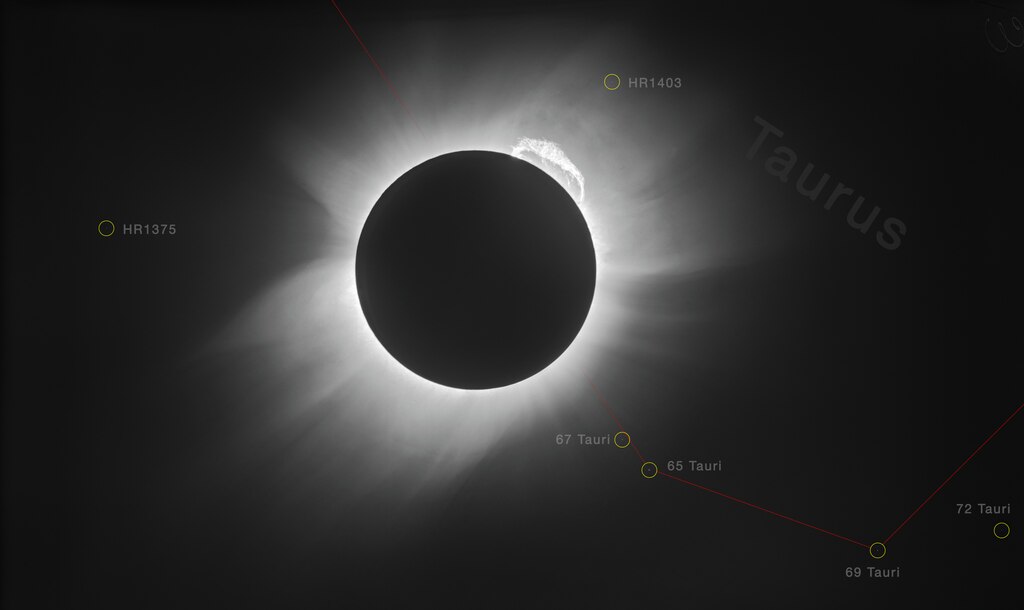
On October 10, 1912, scientists worldwide had a unique opportunity. Albert Einstein, a German physicist, had proposed several hypotheses regarding the Sun’s ability to bend light. A total solar eclipse on that day allowed scientists to measure the bending of starlight caused by the Sun’s gravitational pull, providing a chance to test Einstein’s theories for the first time.
Einstein’s 1911 Theory
In 1911, Einstein proposed a critical theory called the Equivalence Principle. This principle suggests that gravitational mass and inertial mass are essentially the same. It states that objects cannot distinguish between being in a gravitational field and experiencing constant acceleration.
Using this theory, Einstein introduced the concept of “spacetime,” in which space and time are unified into a four-dimensional continuum. Objects with significant mass, such as planets and stars, can bend spacetime, which we perceive as gravity. Building on this principle, Einstein theorized that gravity can also bend or deflect light beams as they pass near massive objects, such as the sun.
Total Solar Eclipse
The projected total solar eclipse on October 10, 1912, provided scientists and astronomers the perfect opportunity to test Einstein’s Equivalence Principle.
The path of totality for this eclipse was visible from Ecuador, Colombia, Peru, and Brazil, while partial totality could be seen in North America, South America, Antarctica, and Africa. Maximum totality lasted for nearly 2 minutes. Expeditions from various institutions were sent to Brazil to conduct measurements and collect data to support Einstein’s 1911 theories.
Unsuccessful, Yet Significant
Despite careful planning for the expeditions to Brazil to collect data, all efforts were hindered by severe thunderstorms and heavy rainfall. The sky was too overcast to gather any significant information about the bending of light.
Although the solar eclipse in 1912 did not allow observers to collect the necessary data to support Einstein’s theory, it marked their initial attempt at such measurements. This event also laid the foundation for more successful observations in the future, most notably by Arthur Eddington during the 1919 solar eclipse.