
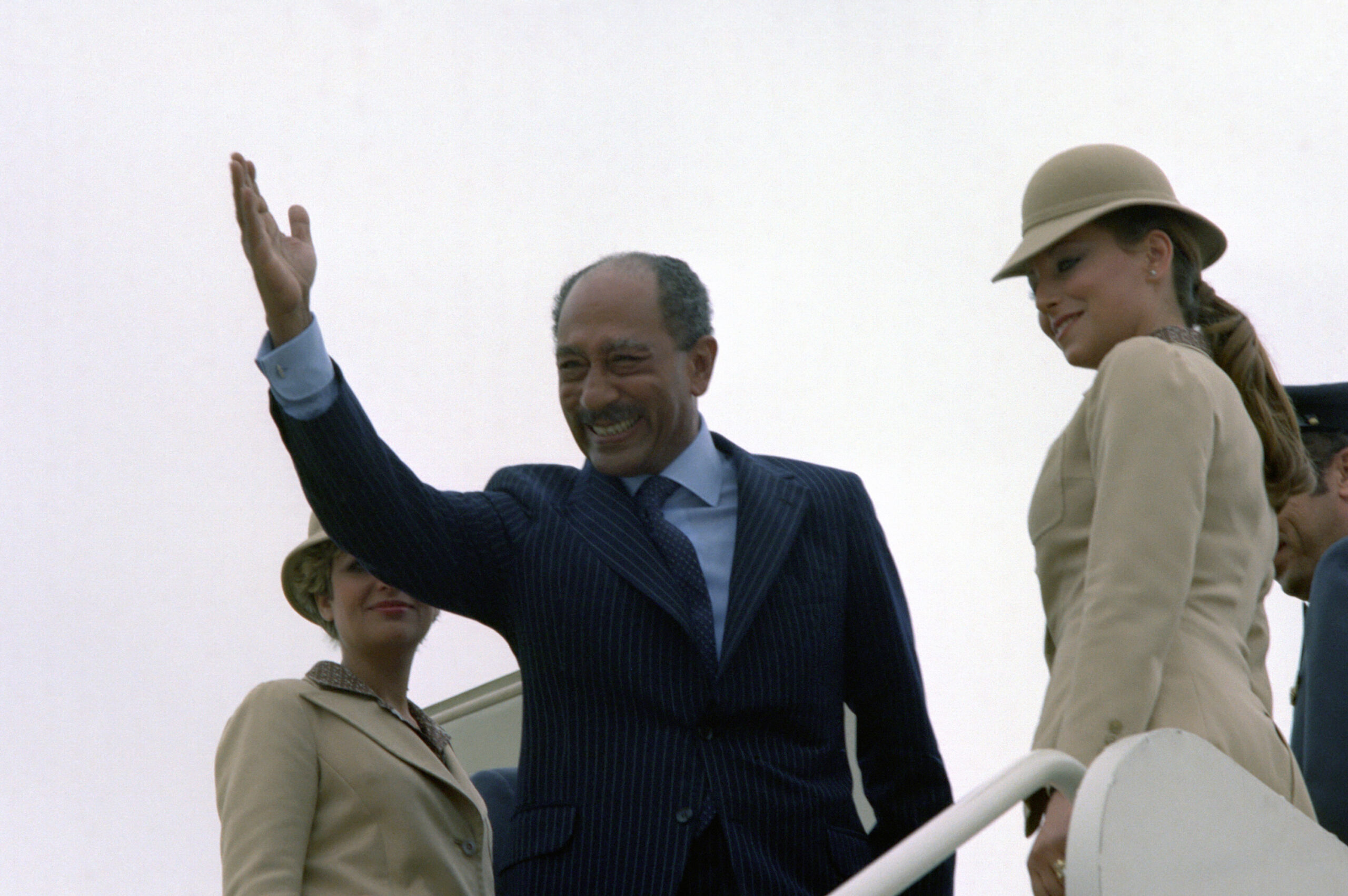
Egyptian President Anwar Sadat was assassinated during a military parade in Cairo on October 6, 1981, in front of the entire world. This annual event commemorated Egypt’s crossing of the Suez Canal during the 1973 Yom Kippur War. The parade became the setting for one of the most shocking political assassinations in modern history.
Sadat was a decorated war hero and a Nobel Peace Prize laureate who became a deeply polarizing figure over the years. His landmark peace agreement with Israel, the 1978 Camp David Accords brokered by U.S. President Jimmy Carter, brought him praise in the West but condemnation throughout the Arab world. In 1979, Egypt became the first Arab country to formally recognize Israel, a decision that led to its suspension from the Arab League and resulted in fierce backlash from hardline Islamists and nationalist factions.
The Background
The seeds of Sadat’s assassination were sown in this climate of domestic unrest and international alienation. Islamist groups like Egyptian Islamic Jihad and al-Jama’a al-Islamiyya, once tolerated by Sadat in an effort to counterbalance leftist influence, turned against him. His peace efforts were seen as a betrayal, and by 1981, opposition had reached a boiling point.
In September 1981, Sadat ordered a substantial crackdown, arresting over 1,500 people, including Islamists, intellectuals, and even Christian clergy. His approach failed to stop the plot brewing within the very institution meant to protect him: the Egyptian military.
During the parade on that fateful day, as jets flew overhead and tanks rolled by, Lieutenant Khalid Al-Islambuli, part of an artillery unit, led the assassination squad. Hidden in a troop truck, the attackers dismounted, launched grenades, and opened fire. Sadat, initially believing the commotion was part of the display, stood to salute. Moments later, he lay mortally wounded.
The Attack
The entire attack lasted less than two minutes and resulted in the deaths of 11 people, with 28 others injured, including dignitaries from the U.S., Ireland, and Oman. Sadat was pronounced dead shortly after arriving at the military hospital. His injuries included severe internal bleeding and lung damage.
The Fallout
The fallout was immediate and global. While many Arab governments silently approved, with headlines in Syria dubbing him the “ultimate traitor,” world leaders mourned. His funeral was attended by former U.S. Presidents Nixon, Ford, and Carter, as well as Israeli Prime Minister Menachem Begin. The sitting U.S. President, Ronald Reagan, did not attend due to security concerns.
Sadat was buried at the Unknown Soldier Memorial in Cairo. His epitaph reads: “Hero of War and Peace,” a testament to a leader whose life embodied both confrontation and reconciliation. His successor, Hosni Mubarak, who was injured in the attack, assumed the presidency eight days later and ruled for nearly three decades.