
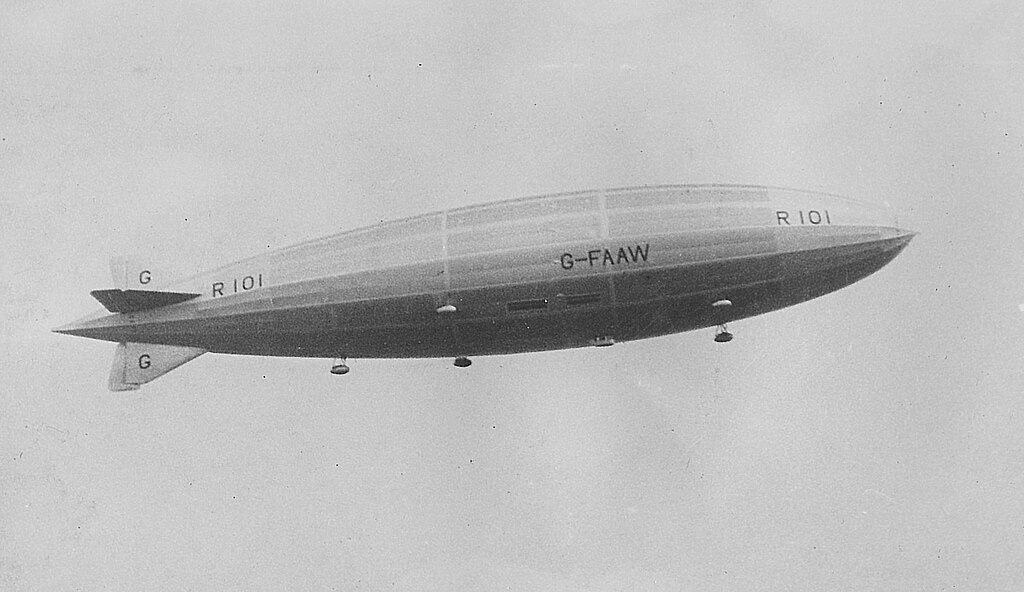
On October 5, 1930, Britain’s grand experiment in airship innovation, R101, ended in fiery disaster. Just hours into its maiden international voyage, the massive airship crashed near Beauvais, France, killing 48 of the 54 people on board. What was meant to be a luxurious leap into the future became a cautionary tale of ambition pushed too far, too fast.
The Dream: Britain’s Imperial Air Route
The R101 wasn’t just another airship. It was a symbol. Backed by the British government, the R101 was designed to connect the vast empire—from London to India and beyond—through the skies. It was part of the ambitious Imperial Airship Scheme, a plan to build six rigid airships for long-distance commercial travel.
Two prototypes were built:
- R100, a conservative design by Vickers Ltd., completed a round trip to Canada.
- R101, the government’s daring project, was packed with new technology and built by the Royal Airship Works.
The R101 was bigger, bolder, and riskier. And it showed.
The Warning Signs: Innovation Without Caution
R101 pushed boundaries—and broke rules.
- First rigid airship to use diesel engines.
- Experimental steel frame and gas valves.
- New materials and manufacturing techniques.
But with all that innovation came problems:
- Engines were underpowered, overweight, and unstable.
- Gasbags leaked, and buoyancy was inconsistent.
- The ship’s skin tore easily, especially in the rain.
Despite troubling test flights and serious design flaws, political pressure mounted. Key officials—including the Secretary of State for Air Lord Thomson—insisted the ship fly to India. He would be on board himself. The flight was rushed. The airship wasn’t ready.
The Crash: Over France, Into Fire
On the rainy night of October 4, 1930, R101 lifted off from Cardington, England. By 2 AM on October 5, it was fighting fierce winds over northern France.
Above Beauvais, the airship faltered.
- Strong gusts tore its nose, exposing a gasbag.
- Rain soaked the fabric, dragging the nose down.
- The ship dove steeply, recovered briefly, then plunged again.
The R101 struck the ground at just 13.8 mph. Survivors recalled a soft landing—then horror. The impact twisted a hot engine, causing it to leak hydrogen. Flames engulfed the craft. Within moments, 48 lives were lost.