
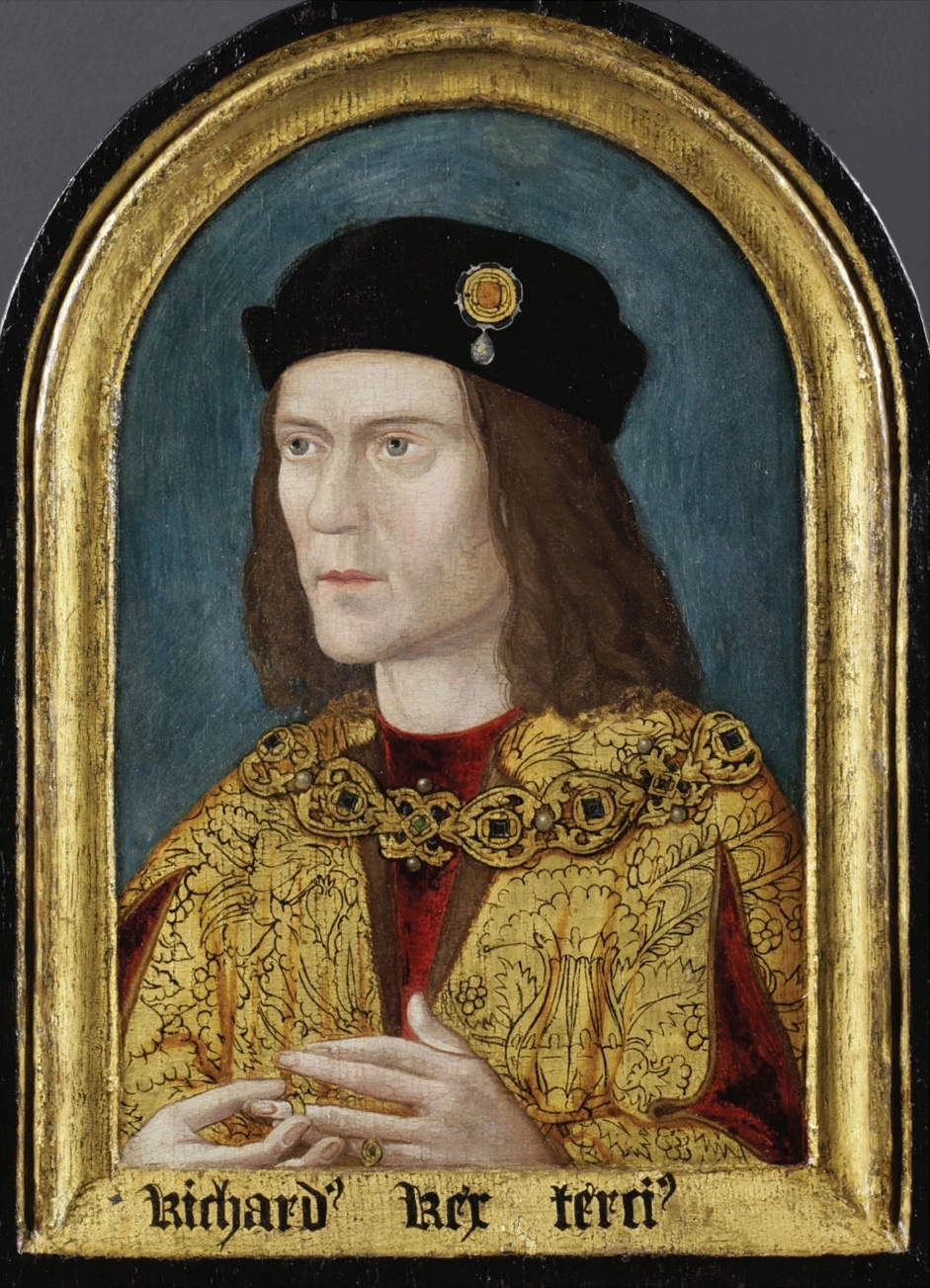
On October 2, 1452, Richard of York, later King Richard III of England, was born in Northamptonshire at Fotheringhay Castle. His life would unfold against the backdrop of the Wars of the Roses, a brutal dynastic conflict between the houses of York and Lancaster that shaped the course of English history.
Early Life and Family
Richard was the eleventh child of Richard, 3rd Duke of York, and Cecily Neville. As the youngest surviving son, he wasn’t really expected to play a central role in national politics. Yet the turbulence of his era would draw him into the heart of England’s struggle for power. The Yorkist claim to the throne, derived through his father’s descent from Edward III, placed his family in direct rivalry with the ruling Lancastrians.
Richard’s childhood was marked by upheaval. Following his father’s death at the Battle of Wakefield in 1460, the young boy and his brother George sought refuge in the Low Countries before returning to England when their elder brother Edward seized the throne as Edward IV in 1461. Richard was soon made Duke of Gloucester and knighted, marking the beginning of his lifelong career in military and political service.
Training and Rise to Power
Much of Richard’s youth was spent under the tutelage of his powerful cousin, Richard Neville, Earl of Warwick, nicknamed the “Kingmaker.” At Warwick’s Middleham Castle, Richard trained in the martial and administrative skills expected of a nobleman, Richard III of England. He also formed lasting connections, including with Anne Neville, Warwick’s daughter and his future wife.
Loyalty to his brother Edward IV defined Richard’s early career. He fought bravely in decisive battles such as Barnet and Tewkesbury in 1471, earning a reputation as a skilled commander. By marrying Anne Neville in 1472, Richard solidified his power in northern England, where he governed with authority and established a formidable regional base.
Seizing the Throne
The turning point came in April 1483, when Edward IV died unexpectedly. His heir, Edward V, was only twelve at the time. Richard was named Lord Protector, but within months, he declared his nephew illegitimate and took the crown himself on June 26, 1483. This act remains one of the most controversial episodes in English history.
Central to Richard’s dark reputation is the fate of Edward V and his younger brother, Richard of Shrewsbury, remembered as the “Princes in the Tower.” They vanished from public view during his reign, and suspicion of their murder has long shadowed Richard’s legacy.
Death and Legacy
Richard’s reign was brief, lasting a little over two years. He was killed at the Battle of Bosworth Field on August 22, 1485, while fighting against the forces of Henry Tudor. His death signaled the end of the Plantagenet dynasty and the beginning of the Tudor era under Henry VII. Notably, Richard was the last English king to die in battle.
For centuries, chroniclers and dramatists—most famously William Shakespeare—painted Richard III as a ruthless villain. Modern historians, however, present a more balanced view, noting his administrative reforms and loyalty to his allies, while acknowledging the shadow cast by the disappearance of the princes.