
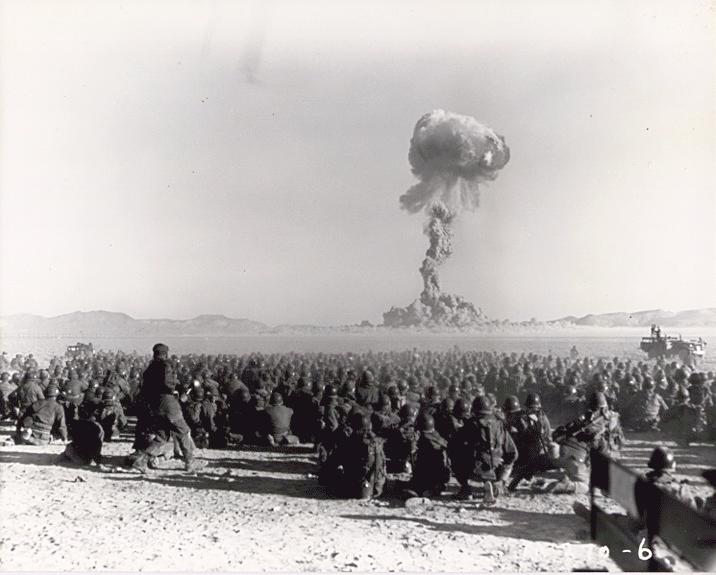
During the heightened anxiety and tension of the Cold War nuclear arms race, the United States sought ways to develop and test nuclear weapons while minimizing societal impact. On September 19, 1957, they successfully conducted the Rainier Event, which was the first fully contained underground nuclear test.
The Lead Up
The escalating nuclear arms race between the Soviet Union and the United States drove both countries to develop more advanced and tactically diverse weapons. However, testing these powerful devices presented a significant problem for both nations. How could they safely test such explosive weapons without risking harm to people?
In 1954, the United States conducted a series of tests known as Operation Castle. The first detonation of Operation Castle, dubbed Castle Bravo, resulted in a significantly larger fallout than expected, contaminating areas where both Japanese and U.S. servicemen were stationed. This incident sparked considerable controversy regarding nuclear testing. In response, the National Academy of Sciences called for stricter regulations and safer protocols for atomic tests. Additionally, scientists intensified their efforts to find alternative detonation methods.
Operation Plumbbob
Following the perceived failure of Operation Castle, scientists actively sought alternative methods for nuclear testing to minimize fallout. They conducted experimental tests from high drop zones, utilized balloon drop techniques, and explored the concept of underground detonations. Operation Plumbbob was a series of controversial tests conducted by the United States to evaluate new nuclear designs using the underground format from May to October 1957.
Approximately 18,000 United States service members participated in Operation Plumbbob at a nuclear testing site in Nevada. The tests were conducted to study the effects of blasts on civil and military structures, develop strategies and techniques for operating in a nuclear blast zone, establish safety protocols for the accidental detonation of explosive components, and test newly developed nuclear weapons and methods of explosion.
On September 19, 1957, the United States conducted the Rainier event as part of Operation Plumbbob. This military exercise involved detonating a nuclear explosive underground, deep in a tunnel at the Nevada testing site. The event was deemed successful because it effectively minimized the fallout from the detonation, demonstrating that underground testing was a viable method for testing new nuclear devices.
Impact
Rainier’s impact was significant because it marked the first time a nuclear bomb was detonated in a way that allowed for complete containment. This meant that no radioactive fallout was released into the atmosphere. The successful containment demonstrated that underground detonation is a much safer method for testing explosives.
The Rainier event provided scientists with an opportunity to study the effects of underground explosives on geology and significantly impacted the future of nuclear testing and arms control.