
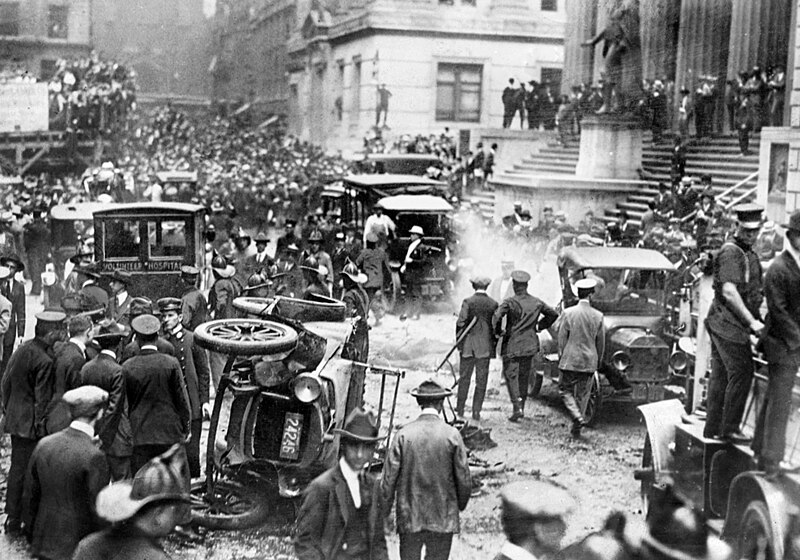
On September 16, 1920, a tragic and unsolved crime occurred when a horse-drawn wagon exploded outside a J.P. Morgan & Co. building in New York City. This bombing resulted in the deaths of over 40 people and injured more than 100 others. To this day, the incident remains unresolved, as the perpetrators were never identified. It is considered one of the deadliest terrorist attacks on U.S. soil at the time.
The Bombing
Around noon on the day of the bombing, the street was bustling with people hurrying to and from lunch. A wagon pulled up and parked at the intersection of Wall and Broad Streets, right outside the J.P. Morgan & Co. building, which is considered a symbol of American capitalism. Shortly after the wagon came to a stop, a powerful explosion occurred, instantly obliterating the horse and wagon. The sound of the blast was so intense that people as far away as lower Manhattan reported hearing it.
After the investigation, it was determined that the explosive device contained 100 pounds of dynamite and over 500 pounds of cast iron weights, which acted as shrapnel during the explosion. The incident resulted in the immediate deaths of 30 people, while a dozen more later died from their injuries in the hospital. Additionally, hundreds of individuals were injured, and the property damage amounted to millions of dollars.
The Investigation
A formal investigation was launched immediately. Members of the Bureau of Investigation discovered suspicious flyers posted near the crime scene that demanded the release of political prisoners and included threats of death. These threats were reminiscent of those made during an anarchist bombing campaign in 1919, prompting the Bureau of Investigation and police to seek connections between the two events urgently.
But they were ultimately unsuccessful. Though years were spent trying to pinpoint a perpetrator, the investigation eventually went cold. It was dropped in 1940, and no one was ever held accountable for the horrific loss of life.
The Aftermath
The fear of further attacks following the initial incident resulted in an increased police presence on Wall Street and a stronger crackdown on radical political movements, as there were suspicions that the attack was linked to an anarchist group. This heightened security led to rising tensions and intense debates over civil liberties and political activism.
Although this particular incident is largely forgotten by the masses today, it is remembered as an act of terrorism in American history. Despite the horrific attack, Wall Street opened to the public the very next day.