
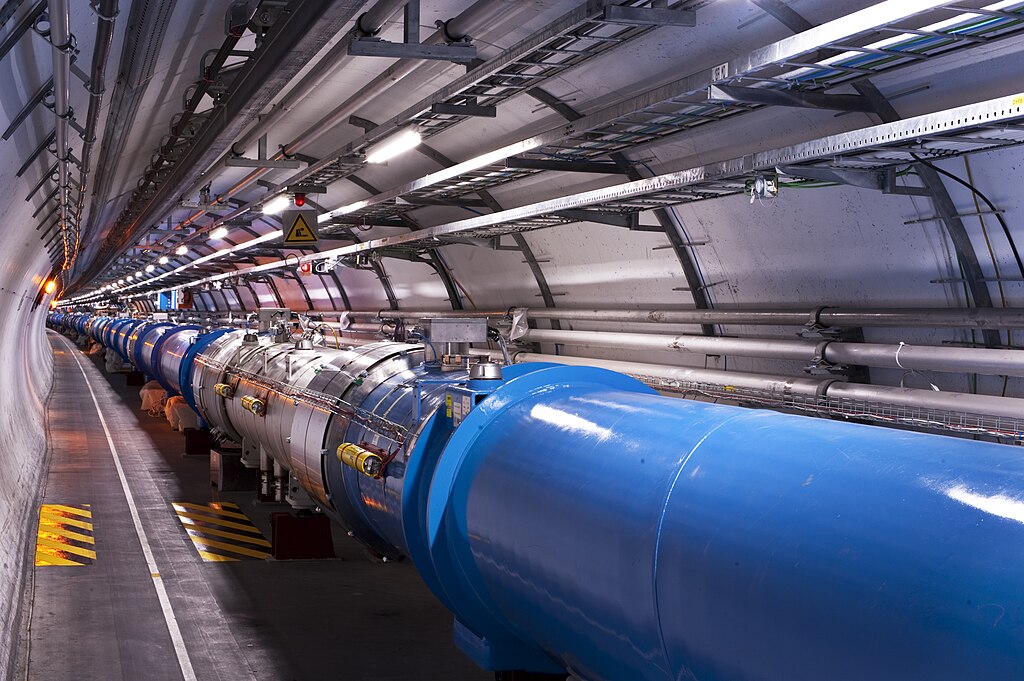
On September 10, 2008, the world’s most powerful scientific instrument was activated beneath the Swiss-French border. At 10:28 a.m., scientists at CERN successfully directed the first beam of particles around the Large Hadron Collider (LHC). This 27-kilometer underground ring was designed to explore the deepest mysteries of the universe.
The World’s Largest Experiment
The LHC was decades in the making and cost over $8 million to build. Its superconducting magnets and ultra-high vacuum systems were engineered to accelerate particles to nearly the speed of light and smash them together, recreating conditions that existed just moments after the Big Bang. The collider is capable of producing up to 600 million collisions per second, making it the most ambitious particle physics project in history.
Located at CERN’s Geneva laboratory, the LHC was not just a European endeavor—it represented a global scientific collaboration involving thousands of researchers and engineers from more than 100 countries. When the first proton beam completed its journey around the ring, it marked the beginning of a new era in experimental physics.
Goals of the LHC
The collider was constructed to address fundamental questions that have long intrigued scientists. One of the main goals was the search for the Higgs boson, a particle proposed in 1964 by Peter Higgs and François Englert, which is essential for understanding how matter acquires mass. Additionally, other experiments aimed to investigate dark matter, a mysterious substance thought to constitute about 25% of the universe, and to explore why there is more matter than antimatter in the cosmos.
Public Concerns and Scientific Confidence
It’s no surprise that the LHC attracted intense public attention, and not all of it was positive. Some skeptics feared that high-energy collisions could create mini black holes or strange matter that might pose a threat to the planet. These claims were dismissed by physicists, including Stephen Hawking, who assured the public that any such phenomena would be harmless and vanish instantly.
Rather than sparking disaster, the LHC’s launch symbolized human ingenuity and international cooperation. “It’s a fantastic moment,” said project leader Lyn Evans, on the day of the first beam. “We can now look forward to a new era of understanding about the origins and evolution of the universe.”
Breakthroughs and Legacy
Although it would take years of testing and upgrades before the collider reached full operational capability, it began producing results fairly quickly. In July 2012, CERN announced that the ATLAS and CMS experiments had detected a particle consistent with the Higgs boson. The following year, François Englert and Peter Higgs were awarded the Nobel Prize in Physics for their theoretical contributions, which were confirmed through the discoveries made by the Large Hadron Collider (LHC).